July inflation came in exactly where economists said it would Wednesday morning, and the market did what it has been waiting six weeks to do. Headline CPI rose 0.1% for the month and 3.4% over the year, down from 3.5% in June. Core rose 0.2% and 2.5%, down from 2.6%. The S&P 500 opened in record territory and closed up 0.3% at 7,748.50 — 9 points shy of the record it set Friday. The Nasdaq added 143.04 points, or 0.5%, to 26,588.49. The Dow slipped 21.58 points to 53,770.27.
The relief was real. On the CME FedWatch tool, the odds the Fed leaves its 3.50%–3.75% target range alone on September 16 jumped to 61.9% from 51.6% the day before. The odds of a quarter-point hike fell to 38.1% from 48.4%.
But the number that actually explains this market wasn't in the CPI report. It was in CoreWeave's balance sheet.
The Print That Moved the Tape
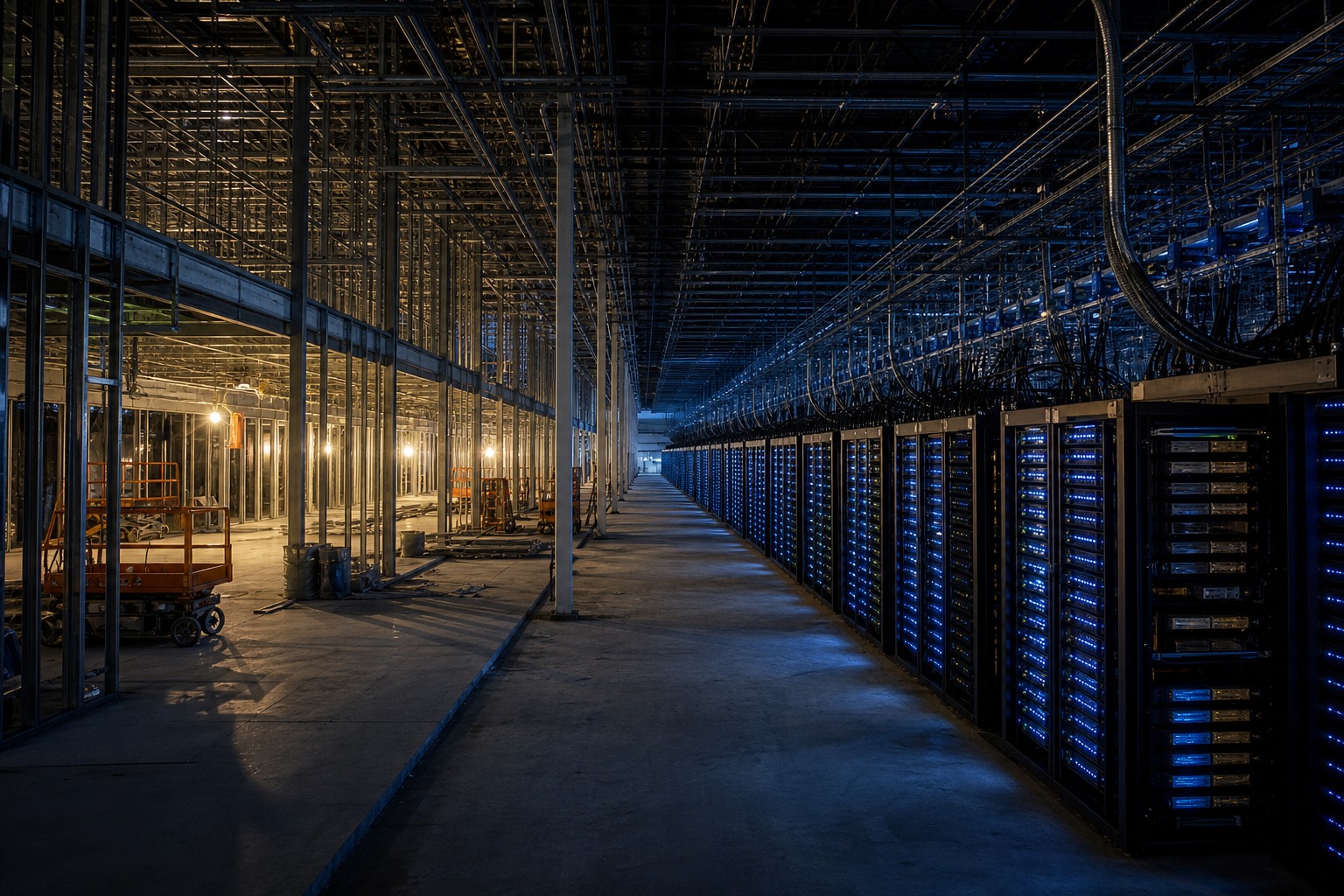
CoreWeave (NASDAQ: CRWV) reported Tuesday after the close, opened Wednesday up 21%, and closed at $107.73 — up 19.28%, its largest one-day gain since March, on 85.8 million shares against a 28.4 million average. Here is what moved it:
Revenue of $2.58 billion, up 112% year-over-year from $1.22 billion
Adjusted loss of $1.03 per share against a consensus loss of $1.20
Revenue backlog of $104 billion, up from $99.4 billion at the end of Q1 — and management said another $25 billion in commitments has already been signed in the opening weeks of Q3
Third-quarter guidance of $3.4 to $3.6 billion, implying 158% growth at the midpoint
Full-year revenue guidance raised to $12.4 to $13.2 billion, with adjusted operating income of $960 million to $1.15 billion
1.5 gigawatts of active power at quarter-end, targeting more than 1.85 GW by December
The stock traded as high as $111.82 and as low as $105.44 intraday, against a Tuesday close of $90.32
CEO Michael Intrator said the newest tranche of contracts carries margins five to ten percentage points better than prior deals. Evercore and Wells Fargo both hold $160 targets. Truist went to $155 from $126. Barclays went to $105 from $90. Even Bernstein, the most cautious voice on the name, lifted its target to $74 from $67.
Nebius Group (NASDAQ: NBIS), the European version of the same business, reported the same morning: revenue up 454% to $582 million, total contracted value quadrupled. The stock rose 18%. Between them, the two neoclouds added roughly $12 billion of market value in a single session.
Now Read the Other Column
CoreWeave's total debt stood at $35 billion as of June 30. At the end of the first quarter it carried $22.7 billion in long-term debt. That is roughly $12 billion of additional borrowing in a single quarter.
Net interest expense: $640 million for the quarter, up from $267 million a year ago
Capital expenditures: $9.4 billion in the quarter — about 3.6 times the revenue it generated
Net loss of $626 million, versus $290 million a year ago
Full-year capex guidance raised to $35 to $39 billion, from $31 to $35 billion three months ago
Read those two lists together and the shape of the thing becomes clear. CoreWeave raised its 2026 revenue outlook by roughly $400 million at the midpoint. It raised its 2026 capital spending outlook by $4 billion. The revenue is compounding. The spending required to produce it is compounding faster.
There is also the question of who the backlog belongs to. Microsoft accounted for approximately 67% of CoreWeave's revenue in fiscal 2025, per the company's own 10-K risk factors, up from 62% in 2024. Meta has committed more than $35 billion across two order forms running to December 2032. Add OpenAI's contracts and a handful of names cover the overwhelming majority of that $104 billion. In the second quarter CoreWeave added Anthropic on a multi-year agreement and a $6 billion commitment from Jane Street — genuine diversification, and still a rounding error against the top two.
The Same Trade, Three Days Running
This is the third consecutive session where the market has been asked to price a very large contracted number against a very large financing number.
Monday it was Riot Platforms, which signed a 20-year, 191 MW lease worth roughly $9.1 billion with a tenant Bloomberg identified as Anthropic — and gave the entire gain back by Tuesday afternoon before closing up 4.33%. Wednesday it was CoreWeave, whose $104 billion backlog is financed by $35 billion of debt maturing into a window that runs from 2026 to 2028.
And underneath both sits Nvidia's move from Monday: memoranda with Apollo, Blackstone, Brookfield, Goldman Sachs, KKR and BlackRock's GIP to mobilize more than $500 billion of third-party capital for AI infrastructure, with Nvidia prepared to backstop a portion of it. On July 1 the company introduced a separate mechanism under which it rents back unused GPU capacity from its neocloud partners at a fixed rate, effectively underwriting a utilization floor so lenders will keep lending.
That is what an industry does when its customers' credit is the binding constraint rather than its own demand. The demand is not in doubt — the electronics cycle turned months ago and has not slowed since. What is in doubt is who carries the balance sheet, and at what rate, when the paper comes due.
What Lands Next
Producer prices land Thursday, and they matter more than usual: PPI feeds the components the Fed actually watches in core PCE, and Wednesday's CPI internals were softer than they looked. Shelter rose only 0.1%, but that was largely a 3.3% drop in hotel prices. The energy index fell 1.5% on the month while still running +14.7% year-over-year, and gasoline is back above $4 a gallon — which means the August print will not get the same help.
The three-month annualized headline rate fell to 0.5% from 2.8%; core fell to 1.6% from 2.3%. That is the disinflation case, and it is a good one. Against it: futures still put the odds of at least one rate hike by year-end at 71.9%, only modestly lower than the 78.8% priced Tuesday. The market got its relief rally Wednesday without anyone actually taking a hike off the table.
Oil is the wild card in both directions. U.S. crude pushed above $83 while Brent slipped below $90, as the odds of reopening the Strait of Hormuz dimmed again. The check the government writes is getting smaller at the same moment energy costs are rebuilding, and the labor market that produced a 23,000-job contraction in July has not gotten stronger since.
CoreWeave's backlog is real. So is the $35 billion. Both statements will remain true right up until the moment one of them stops mattering.
Found this helpful? Share it with others.