Morning Watchlist: Friday Edition
A quick note from Behind the Markets
We're closing out the week — and on Thursday, for twenty minutes, South Korea's stock market simply stopped.
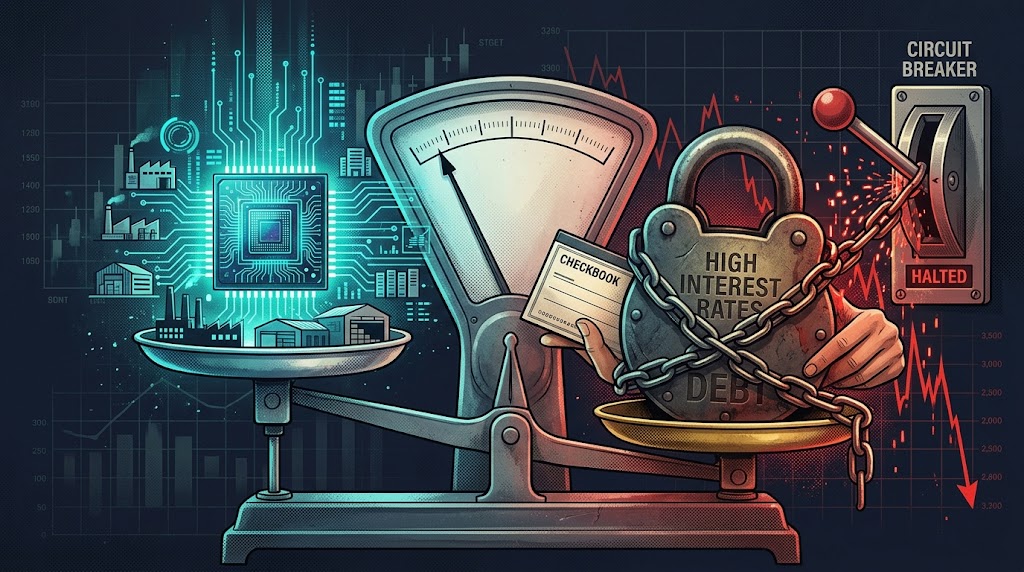
Not on a war. Not on a collapse in chip demand. Trading halted because the selling hit the circuit breaker, and what the sellers were running from, mostly, was the price of money.
Here's the strange part. Hours earlier, the most important chipmaker on Earth reported its sixth straight record quarter and guided even higher.
Record demand. Panicked tape. When both of those are true at once, the crowd has stopped arguing about the product. It's arguing about the checkbook. Three stories this morning. Three pairings.
Let's get into it.
1) Trading Halted in Seoul. The Demand Didn't.
First, the carnage. On Thursday, Seoul's Kospi fell as much as 9% intraday — tripping a market-wide circuit breaker that froze trading for twenty minutes — before closing down 7.6% at 5,554. Samsung fell 9.5%, SK Hynix 11.1%, and foreign investors dumped about $2.7 billion of Korean stock in a single session. Tokyo's Nikkei lost 4.8%. The Philadelphia Semiconductor Index, by Wednesday's close, had shed nearly 12% in nine sessions.
Now the part that doesn't fit. The same morning, TSMC — the foundry that manufactures nearly every AI chip that matters — reported third-quarter revenue up 51% to $46.7 billion, net income up 68.7% to a sixth consecutive record, and a 66.4% gross margin. Then it guided the current quarter as high as $54.3 billion — roughly another 14% at the midpoint. And its own shares fell 2% in Taipei anyway.
So what is the market actually selling? Listen to Kiwoom Securities' Han Ji-young, who said it plainly Thursday: the yardstick for the AI cycle is shifting away from the sheer size of capital spending toward "profitability, cash generation, and financing stability." Wednesday gave that sentence a face. CoreWeave — the AI cloud that rents Nvidia chips to Meta, OpenAI, and the biggest names in AI — fell 15.5% to $65.78 as yields on its unsecured bonds touched 15% and its credit-default swaps blew past 1,000 basis points. Chamath Palihapitiya posted that AI expansion may be inflating a private-credit bubble. Elon Musk's full reply: "Yikes."
This is the creak we've tracked since Oracle's September force-majeure notice and Hock Tan's "casino" warning this week. It just got louder. (Housekeeping: Micron sits well above our $925 flag through the whole panic — still Buy — and ASML-plus-TSMC made it a two-receipt week for chip demand, so our Lam Research, Entegris, and Photronics entrances stand unchanged. We wait.)
The pairing: CoreWeave (CRWV) — Sell
For readers who hold it, and we know that's a painful sentence after a 56% slide from the $150 high. The business is real and growing violently — second-quarter revenue of $2.58 billion, up 112%, against a $104 billion contracted backlog. Nobody is calling the demand fake. TSMC just proved the demand.
We're selling the funding model. CoreWeave builds with borrowed money: $35.6 billion of debt plus $16.3 billion of lease obligations — roughly $52 billion stacked ahead of shareholders, against an equity value near $32 billion. It guided this quarter's interest bill to as much as $940 million against revenue of about $3.5 billion: roughly a quarter of every revenue dollar now leaves for the bondholders before a single electron is paid for. And that $104 billion backlog is not money in the bank — it's a promise that obliges CoreWeave to spend tens of billions it doesn't have, at whatever the debt market charges next. Think of a landlord who pre-sold a decade of leases on towers he hasn't built, and must finish them on a credit card whose rate just went to 15%.
When bonds yield 15%, the lenders — who stand in front of the stockholders — have told you what they think the risk is worth. The honest other side: 27 analysts still average a $144 target, the company is pursuing investment-grade, chip-backed borrowing from insurers its co-founder calls "effectively unlimited" capital, and three customers worth 72% of revenue include some of the richest companies alive. Wrong if that insurer money arrives cheap and fast — then the equity rips and holders left early. We'd rather own this build-out through toll collectors who pay cash, and we already do.
2) The Hottest Number in Five Months
On Wednesday, the September inflation report landed hot — and our cheat sheet from that morning's edition got its answer within the hour. Headline prices rose 3.7% from a year ago, up from 3.4% and above the 3.6% forecast. The monthly gain of 0.6% was the fastest since April. Core inflation ticked up to 2.6%. Gasoline alone jumped 9.1% in a month, with the average pump price setting an all-time record at $4.33.
Wolfe Research's Stephanie Roth, in four words: "This makes the October meeting live." Hike odds for the Fed's October 27–28 meeting went from under 25% to a coin flip, and Thursday's global selloff was partly that coin landing on edge. Principal's Seema Shah added the detail we can't shake: more than half the items in the basket are still rising faster than 3% a year.
Step down from the bond desks to the kitchen table. A 3.7% world with record gasoline is a tax collected weekly from the people least able to pay it — the same squeezed shopper Albertsons' CEO described on Tuesday, the one Dollar General and the trade-down migration have tracked all year. When that shopper's card is full and the bank says no, there is one lender left whose answer is always yes, because it never checks a credit score. It checks the collateral.
The pairing: FirstCash (FCFS) — Watch
FirstCash is the biggest name at the pawn counter, operating pawn stores across the United States and Latin America. A pawn loan is banking stripped to its oldest form: the vault does the underwriting — no credit report, just the wedding ring — and with gold near record prices, the same ring borrows more this year than last. The squeeze shows up in the numbers: second-quarter revenue rose 29.4%, earnings beat, and management has called out accelerating pawn-receivables growth all year. The company even raised its credit line to $1.1 billion in August and is buying Ramsdens, a U.K. pawn chain.
So why Watch and not Buy? The crowd got to the counter first. At Wednesday's close of $216.53, the $9.4 billion company is up almost 50% from its 52-week low, about 9% from its high, at roughly 19 times next year's expected earnings — a thinner discount to the S&P's 21 than we like — with insiders selling and not one open-market buy in ninety days. The entrance: the October 22nd report converting record pawn demand into a raised guide at a saner price, or a markdown toward the $190s. The kill: the consumer actually recovering (good news, bad for pawn volume), credit losses in its point-of-sale lending arm if the labor market breaks, or a gold slide marking down the collateral. Encore, our October 11th Buy, works the other end of this same street — the debt collector and the pawn broker both get busier when the middle of the road gets crowded.
3) The 38% Raise Nobody Noticed
While Seoul was halting trades on Thursday morning, the most boring landlord on Earth published its receipts. Prologis — the world's largest warehouse owner, landlord to the supply chains of Amazon-speed retail — reported third-quarter cash flow per share up 7%, occupancy above 95%, and 60 million square feet of leases signed. It raised its same-store growth forecast. Its shareholders even approved the SEGRO acquisition the same week. CEO Dan Letter name-checked "the build-out of the data center supply chain" as a demand driver.
But one number is the story. When a Prologis lease expired and rolled to a new one, the rent stepped up 38% on a net effective basis — 23% in cash. Not asking rents. Signed ones. Five years of e-commerce growth and construction inflation are embedded in leases that were priced in an older, cheaper world, and every year another slice of them comes up for renewal. (The market's Thursday verdict on the stock landed after we went to press; the leases don't care.)
Prologis trades like the blue chip it is. One aisle over sits a landlord collecting the same raise at a clearance price.
The pairing: STAG Industrial (STAG) — Buy
STAG owns the plain metal boxes by the highway — single-tenant warehouses, one company per building, the unglamorous middle of American logistics. Its second quarter read like a small-print version of Prologis's: operating occupancy 95.5%, renewal rents up 21.4% in cash — and up 38.0% straight-line, the very number the giant just printed. Think of an apartment building where every lease was signed years ago at old rents, and a fifth of them renew each year into today's market. The raise isn't a forecast. It's already in the contracts.
At about $36.36, the $7 billion company costs roughly 14 times its annualized core cash flow — Prologis commands a far richer multiple for the same mark-to-market — with a dividend yielding about 4.2%, and the stock sits within 4% of its 52-week low. (The trailing P/E near 28 is REIT optics; FFO is the metric, same as we flagged on Tanger.) The honest risks: this is a borrowing business carrying net debt at 5.2 times cash flow in a 5% world, a 4.2% dividend has to argue with a 5.3% Treasury — the same argument we respected at Crown Castle and Black Hills — and a genuine freight recession would empty boxes faster than renewals can reprice. The kill: occupancy slipping while the debt rolls over. STAG reports October 27th, with Prologis's rent receipts already on the table.
Before You Go
That's the watchlist. A market that halted on the price of money the same morning demand set another record, an inflation print that reopened the Fed argument, and a 38% raise written into warehouse leases while everyone watched Seoul. One theme, as always: demand was never the question this quarter — the checkbook is — and we'd rather own the landlords and toll collectors who already have one.
Calendar notes, honestly kept: Next week the ledger gets busy: Synchrony, Ally, Western Alliance, and Nasdaq report Tuesday; Crown Castle's entrance exam, Knight-Swift's, and First American's earnings all land Wednesday the 21st; FirstCash follows Thursday. Tomorrow we grade the week's full card.
Found this helpful? Share it with others.
Written by Behind The Markets